Brauer-bützfleth Goélette Aurique (1945) For sale
Description
Antarès is a traditional German construction from the BRAUER shipyard in Hamburg in 1945 made to last, as it was originally built for deep-sea fishing. Originally, this model of ship was built in two copies with the main reason (unofficial however) being the exfiltration of the German authorities. Hidden on the Elbe during the bombings, only Antares survived.
1946: Seizure of war by the Netherlands
1960/1990: Fishing boat under the Dutch flag.
1990/2005: Antarès is bought by a Dutch family who have completely restored it and converted it into a habitable schooner. Sailing in Norway, Sweden and the Baltic.
2005/2010: Passage under the English flag as a training boat and then a ship based on the west coast of Scotland. Antarès has also contributed to the production of the nautical charts of the OPEN CPN software.
(http://www.antarescharts.co.uk/).
2010/2012: Passage under the French flag at its first home port Sanary/Mer. Year of classification as a BIP (Boat of Heritage Interest) in view of its rich history and its ongoing maintenance.
2012/2017: New home port in Marseille and use as a charter boat.
2017 to date: Private pleasure boat.
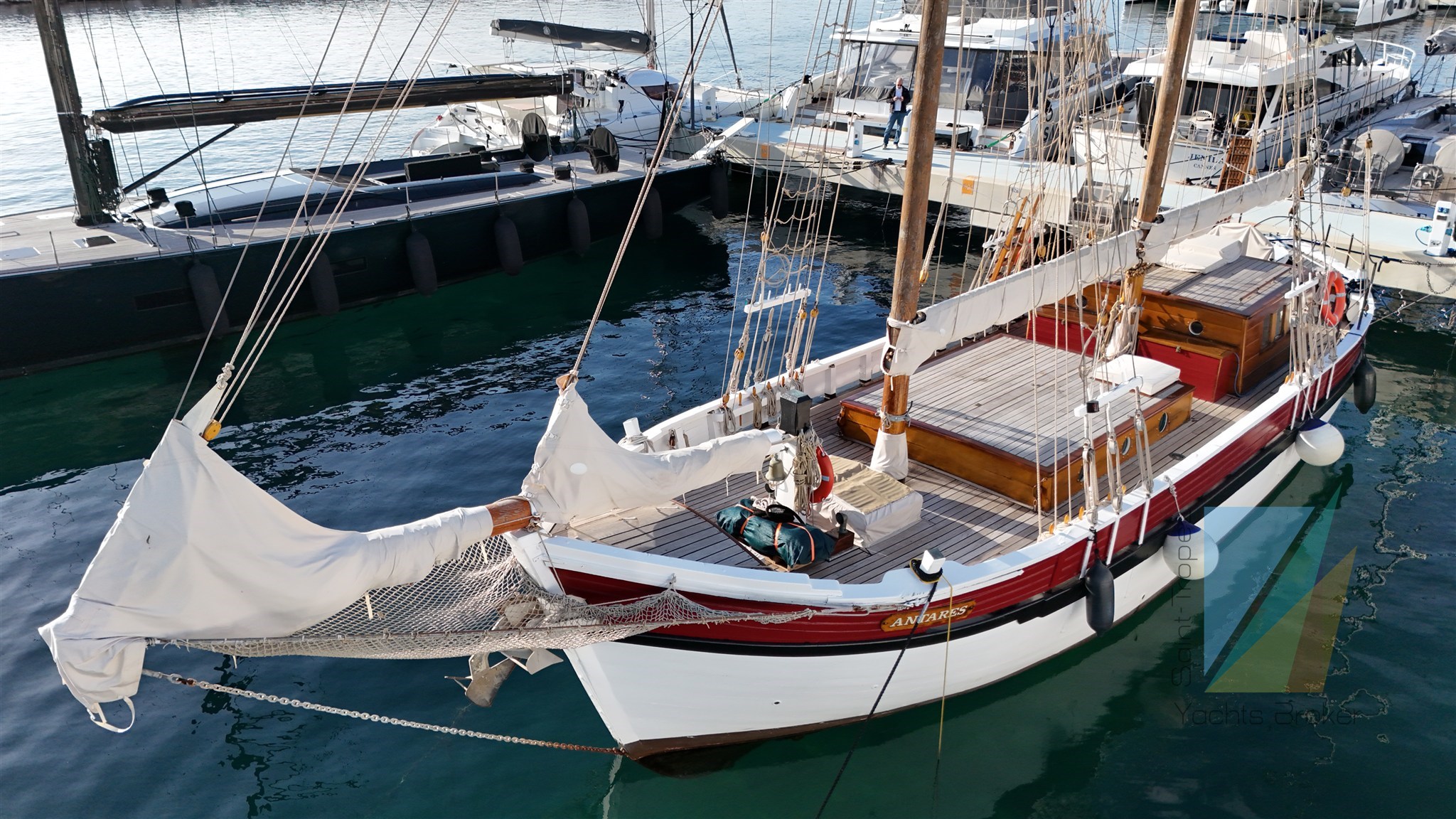
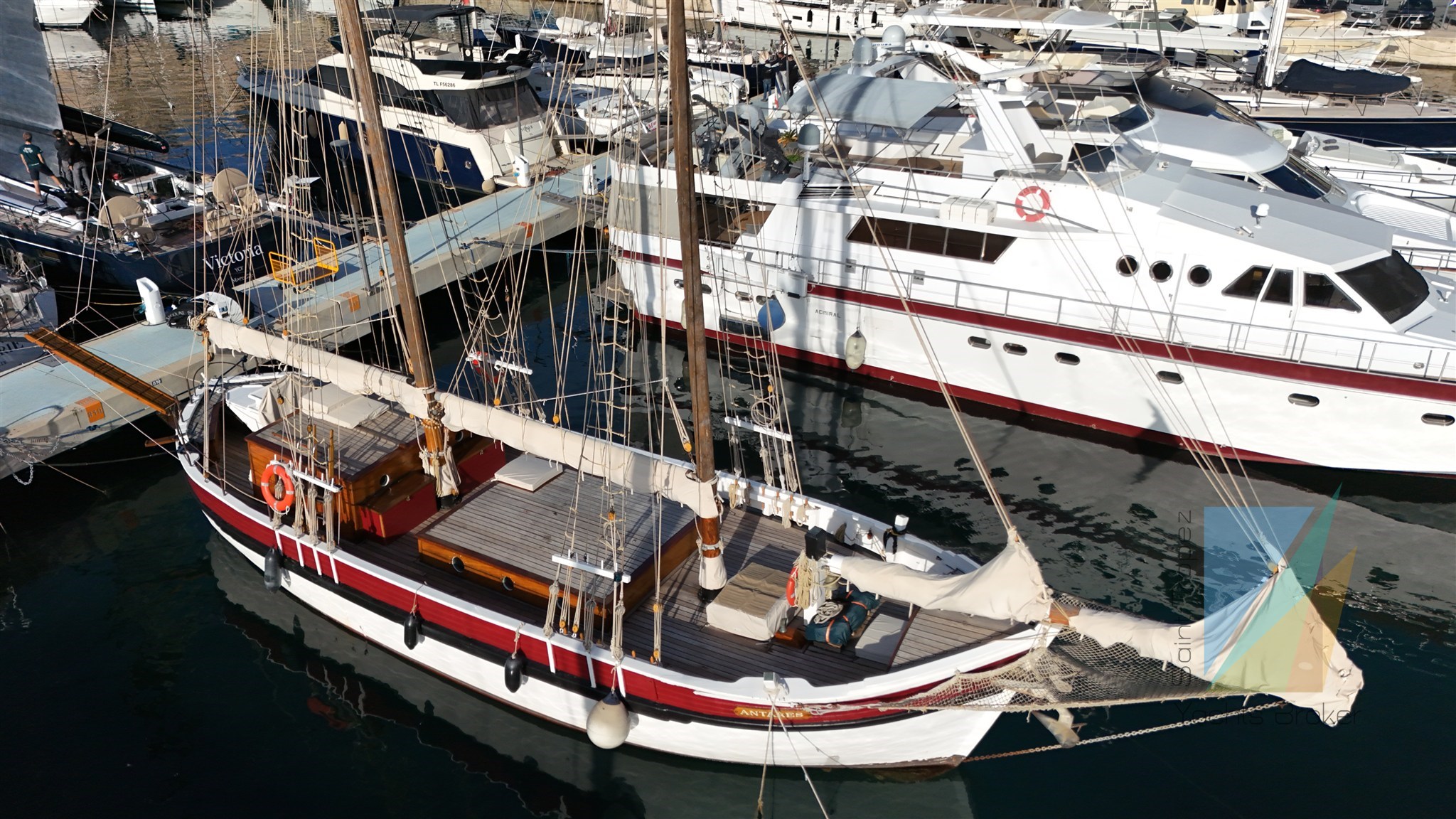
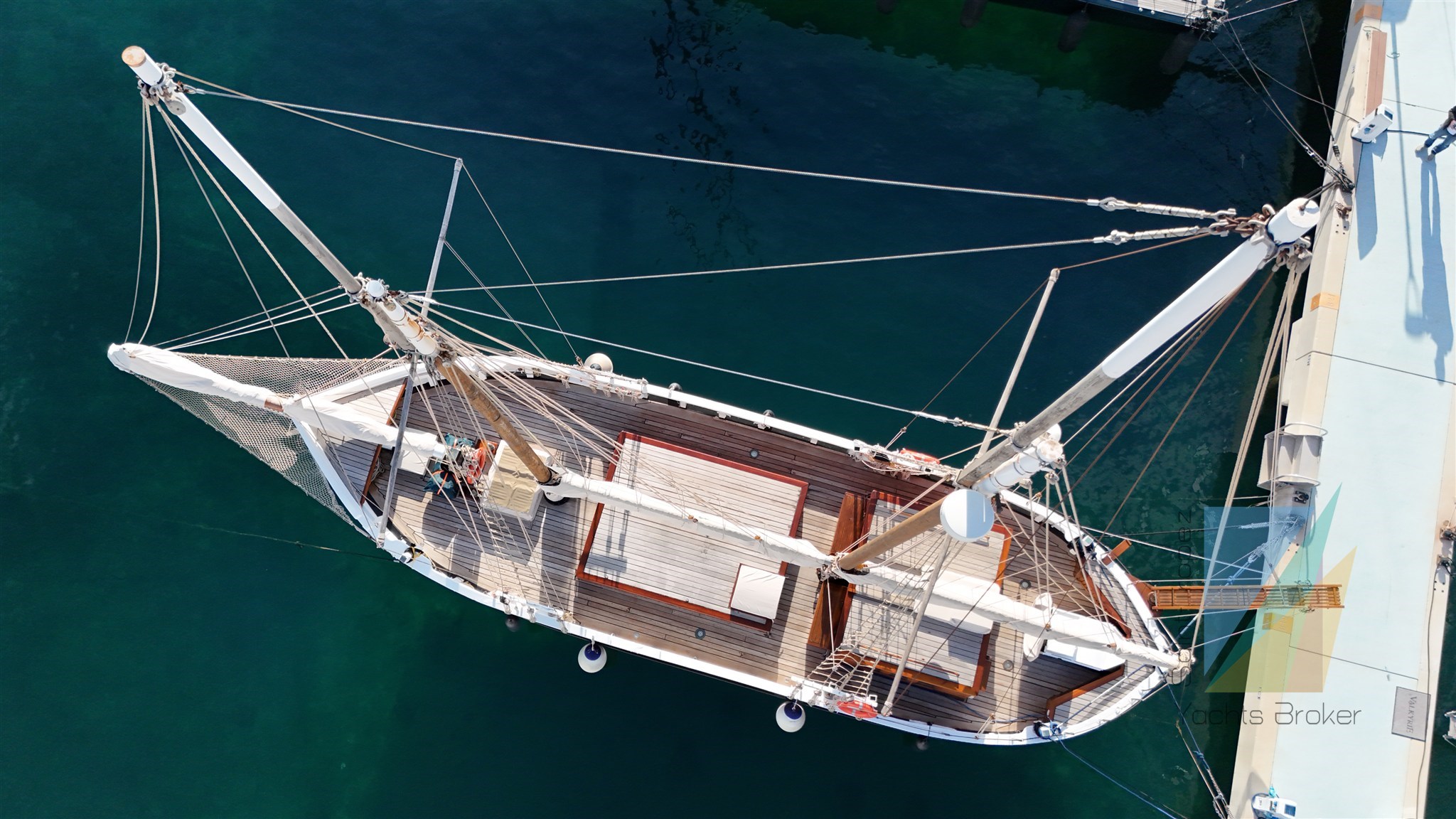
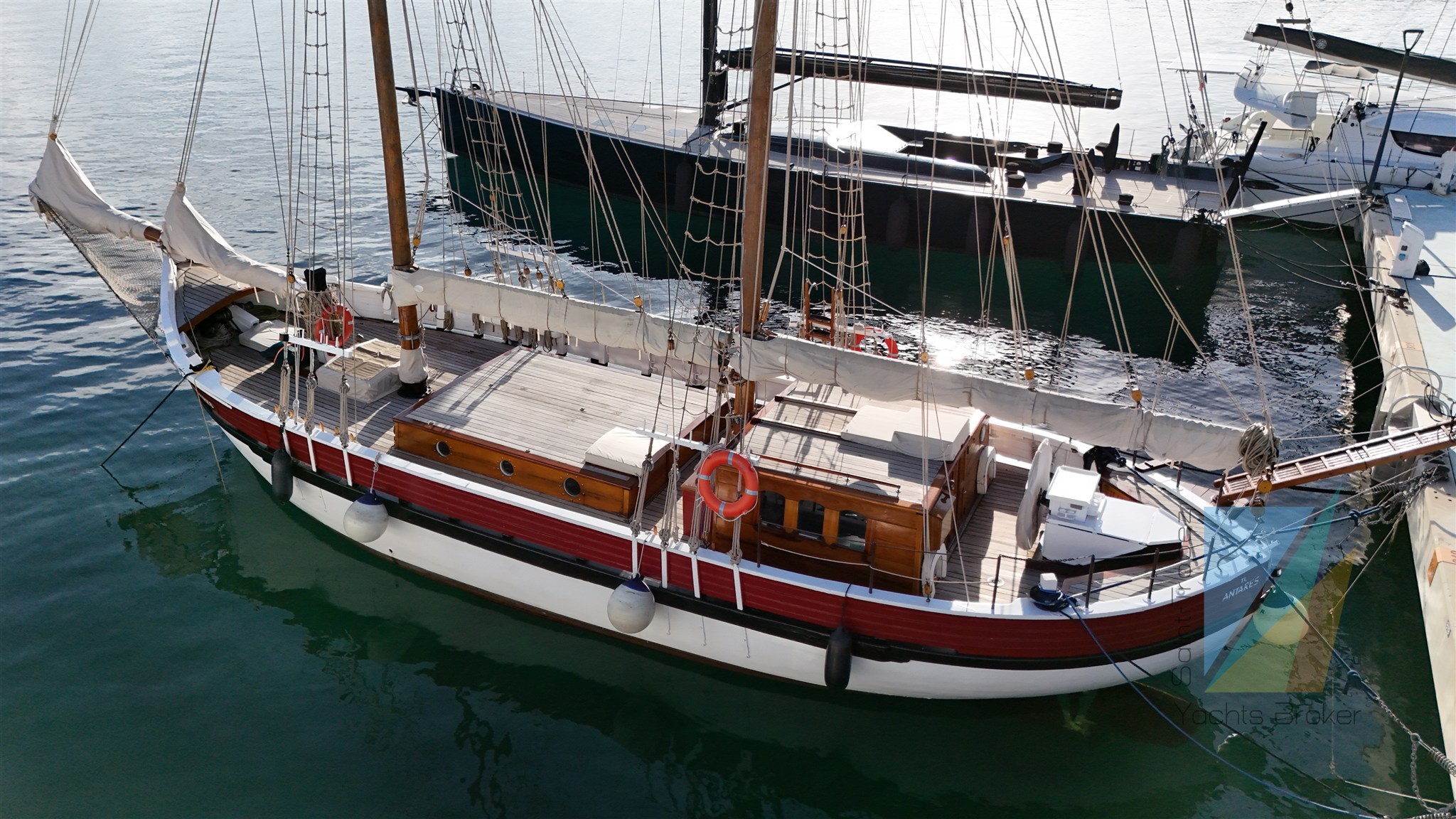
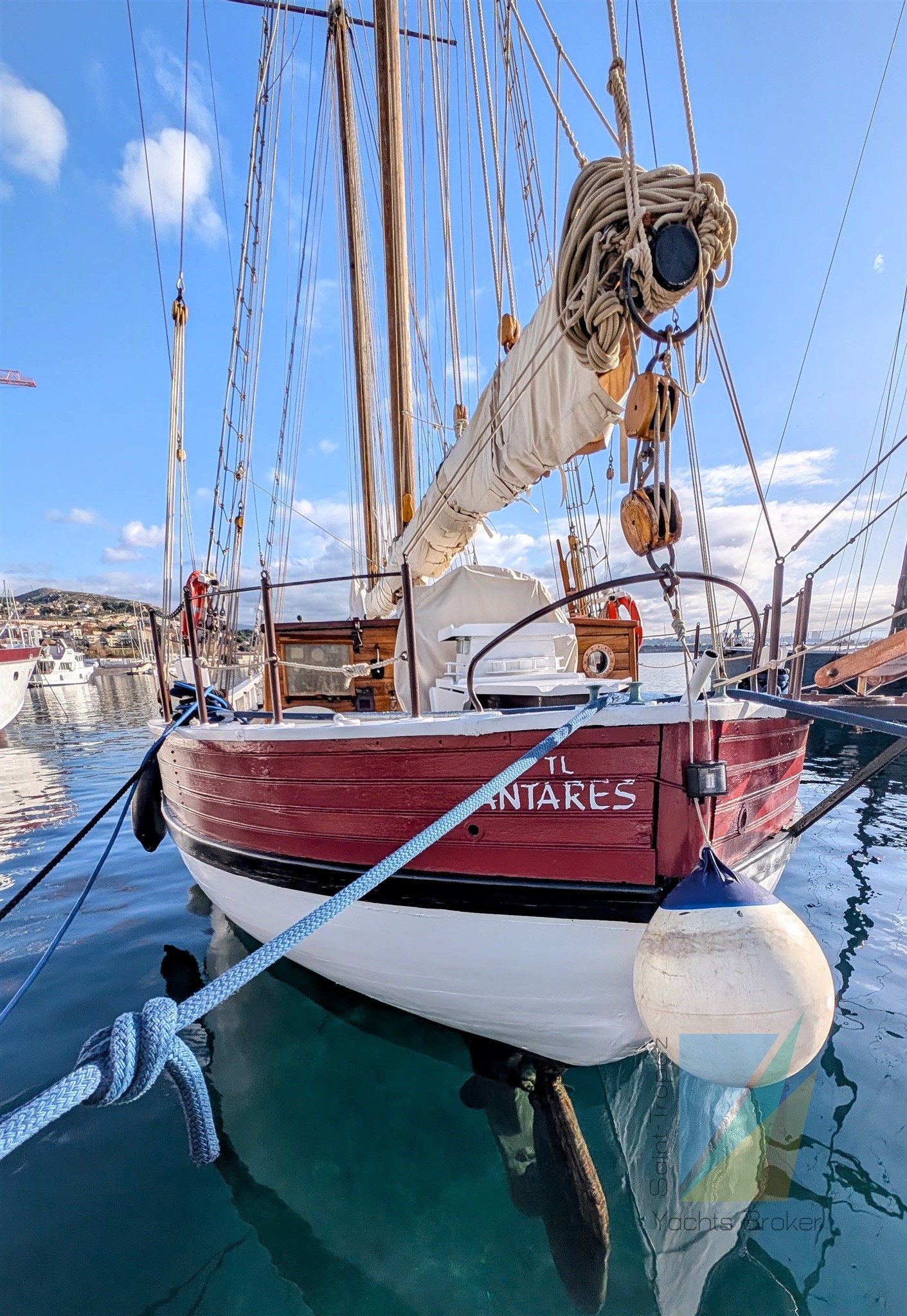
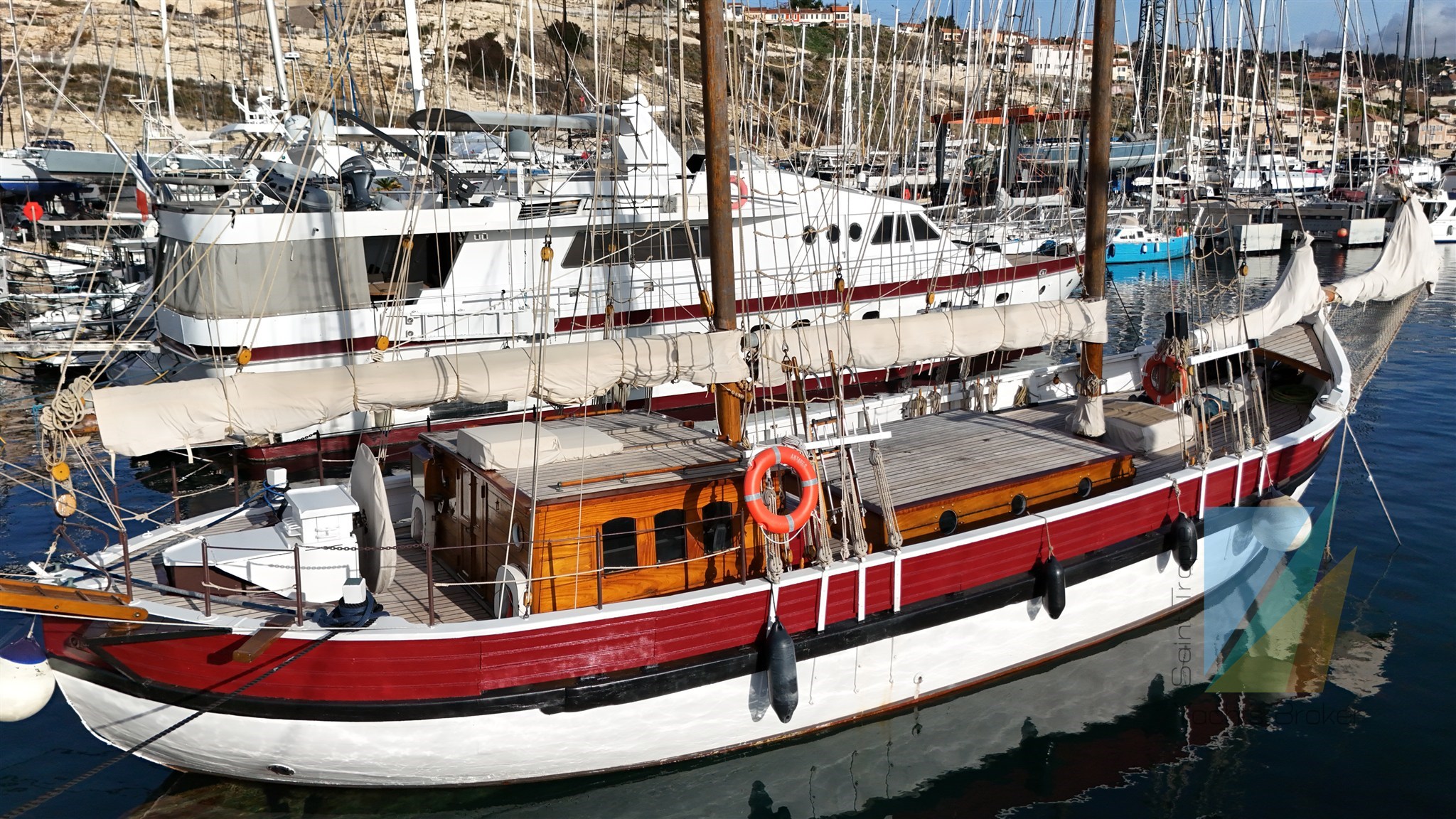
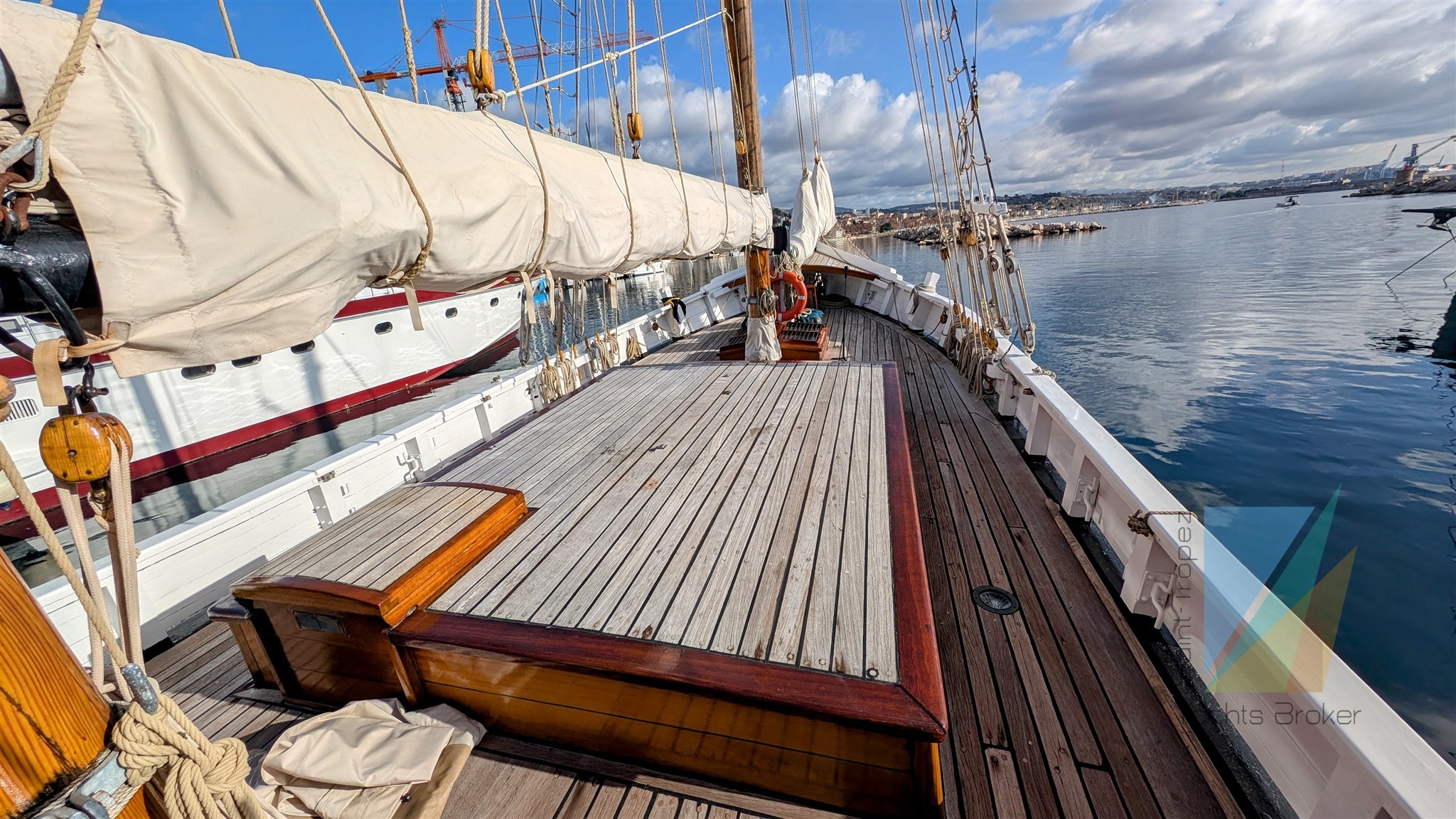
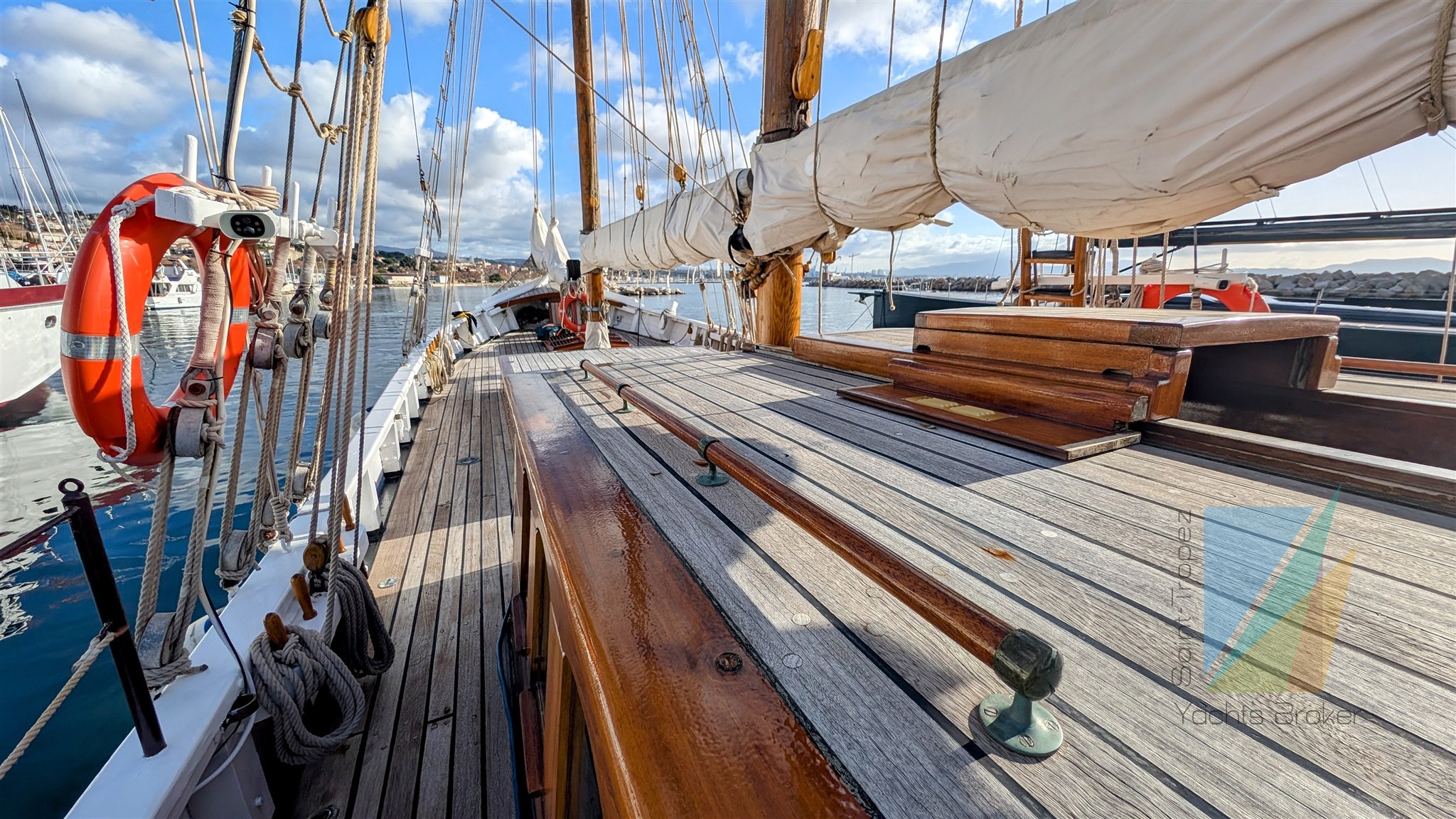
Antarès is a very comfortable and pleasant habitable schooner to live in on a daily basis. Outside, its wide open deck of about 80m² even allows you to carry a 4-seater jacuzzi on the roof. The bow swells and bow net are an inexhaustible playground and jumps for children (adults too!). Inside, it is a real apartment of about 70m² in which you can live all year round (The Dutch family who converted Antarès into a schooner was a couple and their two children who lived on it for 15 years). When sailing, her main sails are majestic and always an emotion that is renewed each time. In addition, Antarès heels very little under sail and is very comfortable.
Type of construction:
Hull: Oak planks (Iroko/Niangon for the changed planking) of 45mm on oak lined chords every 30cm.
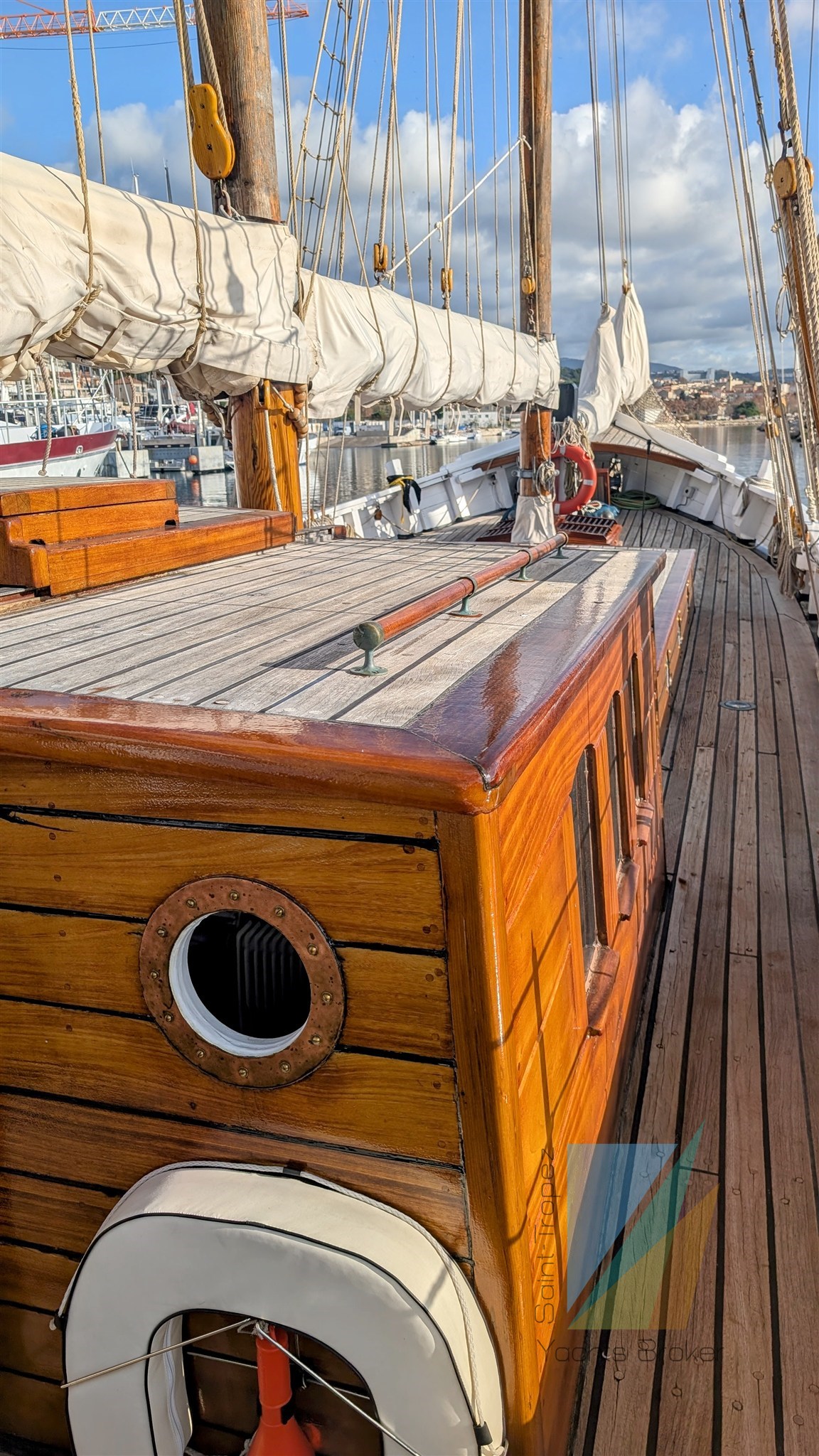
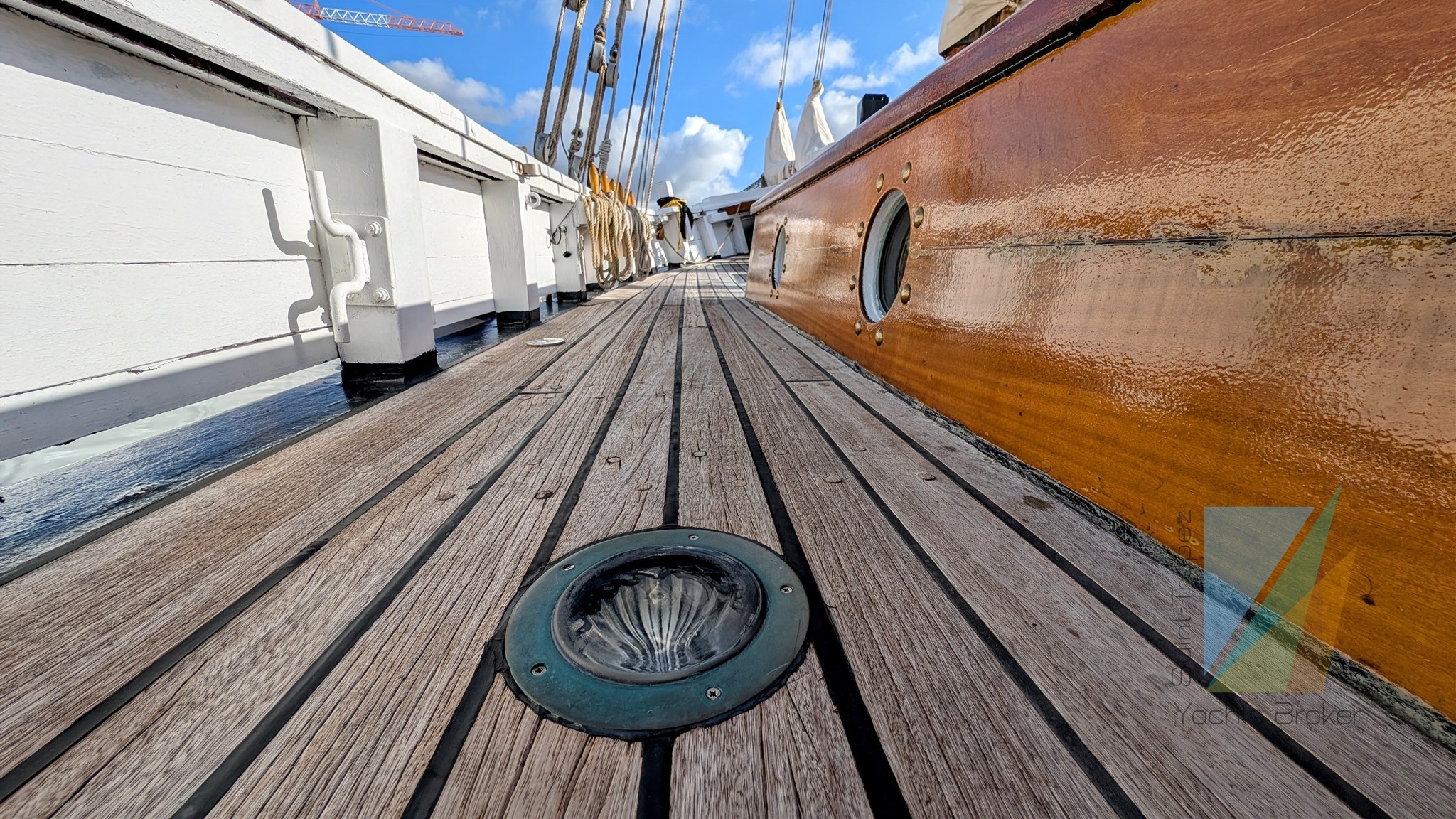
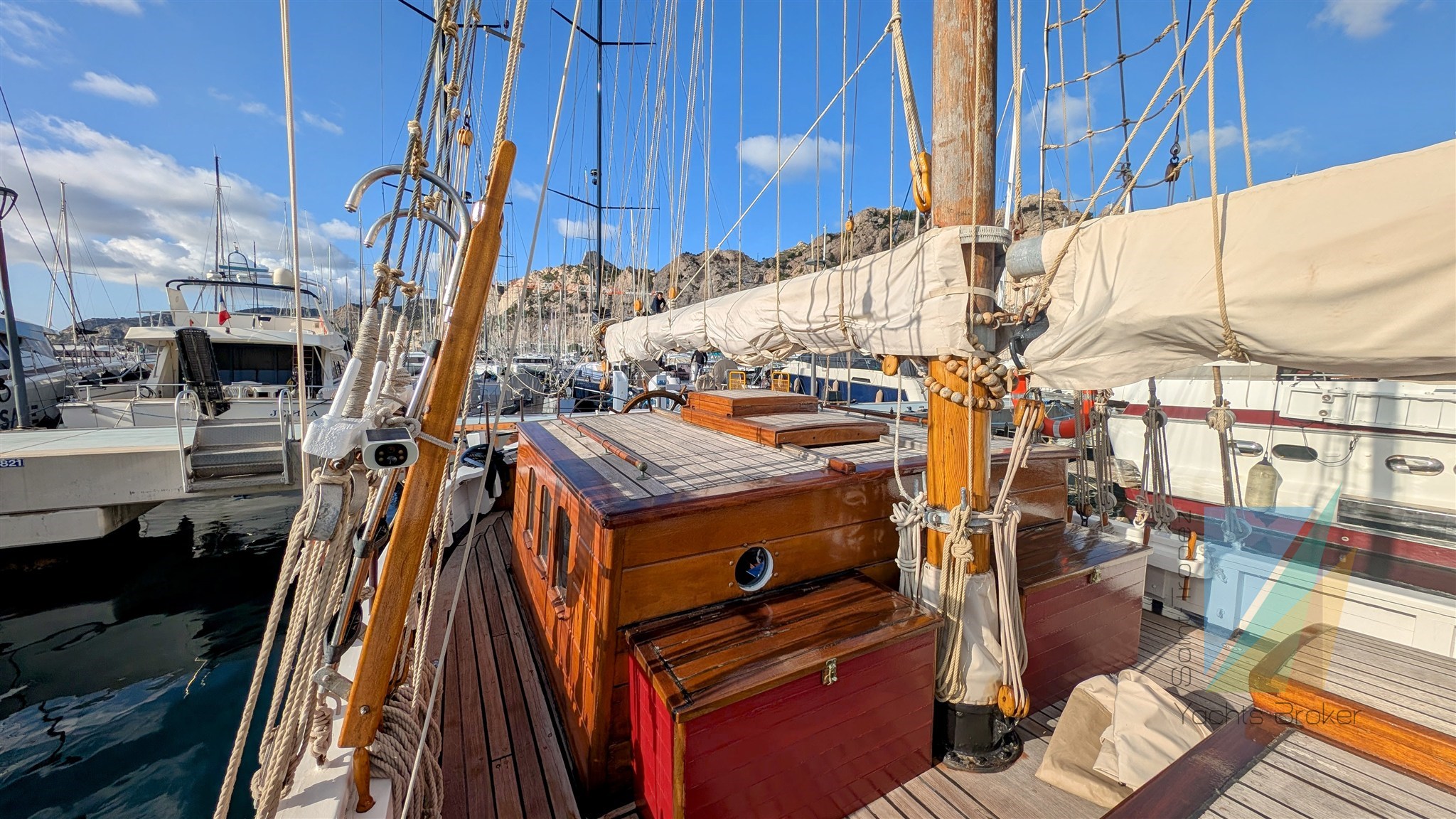
Superstructure: The teak deck (2009) and the interior/exterior of the living areas is made of mahogany.
Current condition: Very good condition as the boat has undergone several major hull restorations in 1990, 1997, 1998, 2006, 2007, 2009, 2011, 2012, 2013, 2016, 2019, 2021, 2024.
1990: Conversion to a pleasure boat
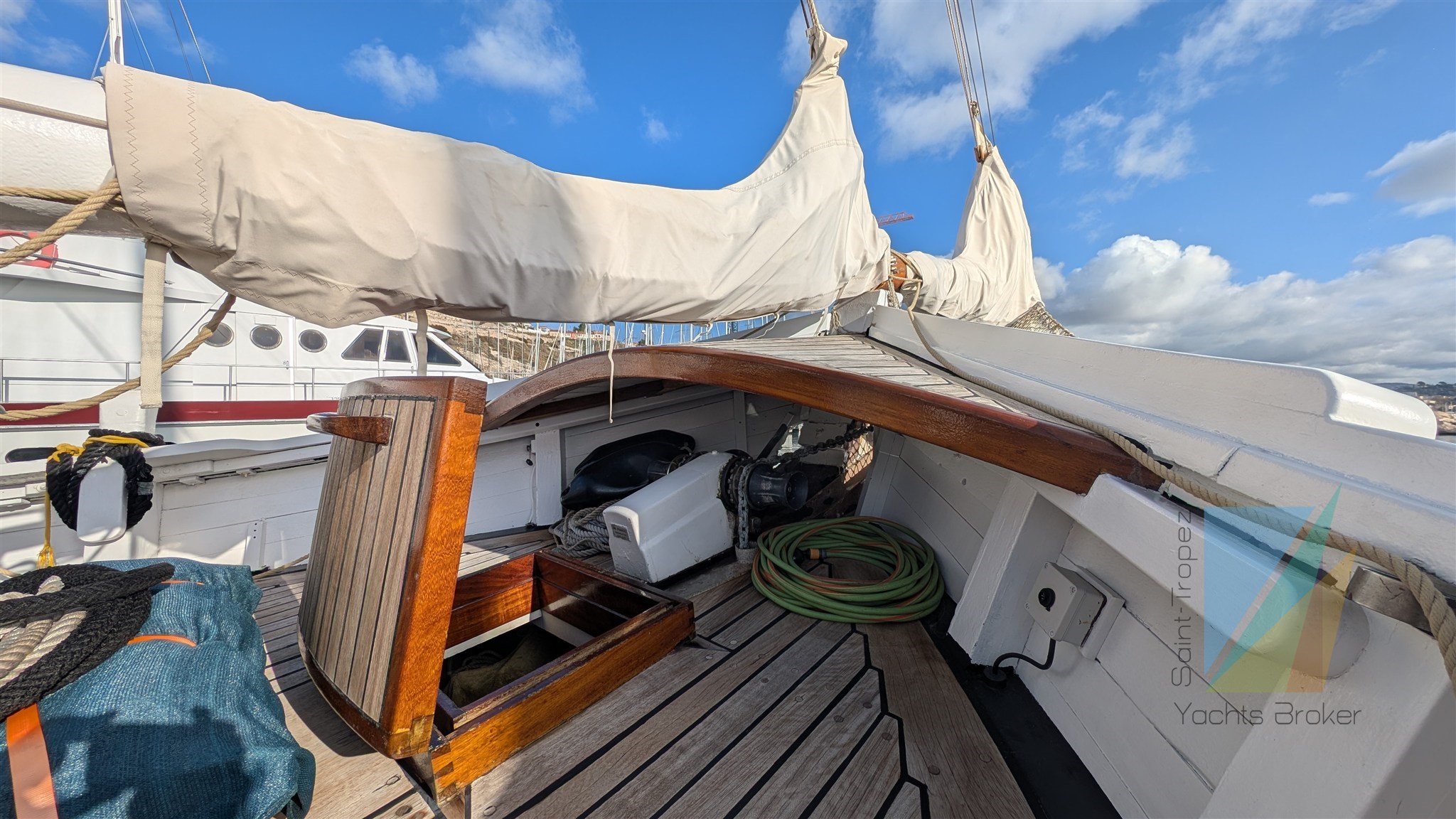
1998: Installation of a 28HP diesel hydraulic power plant - windlass - bow thruster
2002: Restoration of the steering wheel + switch to hydraulics
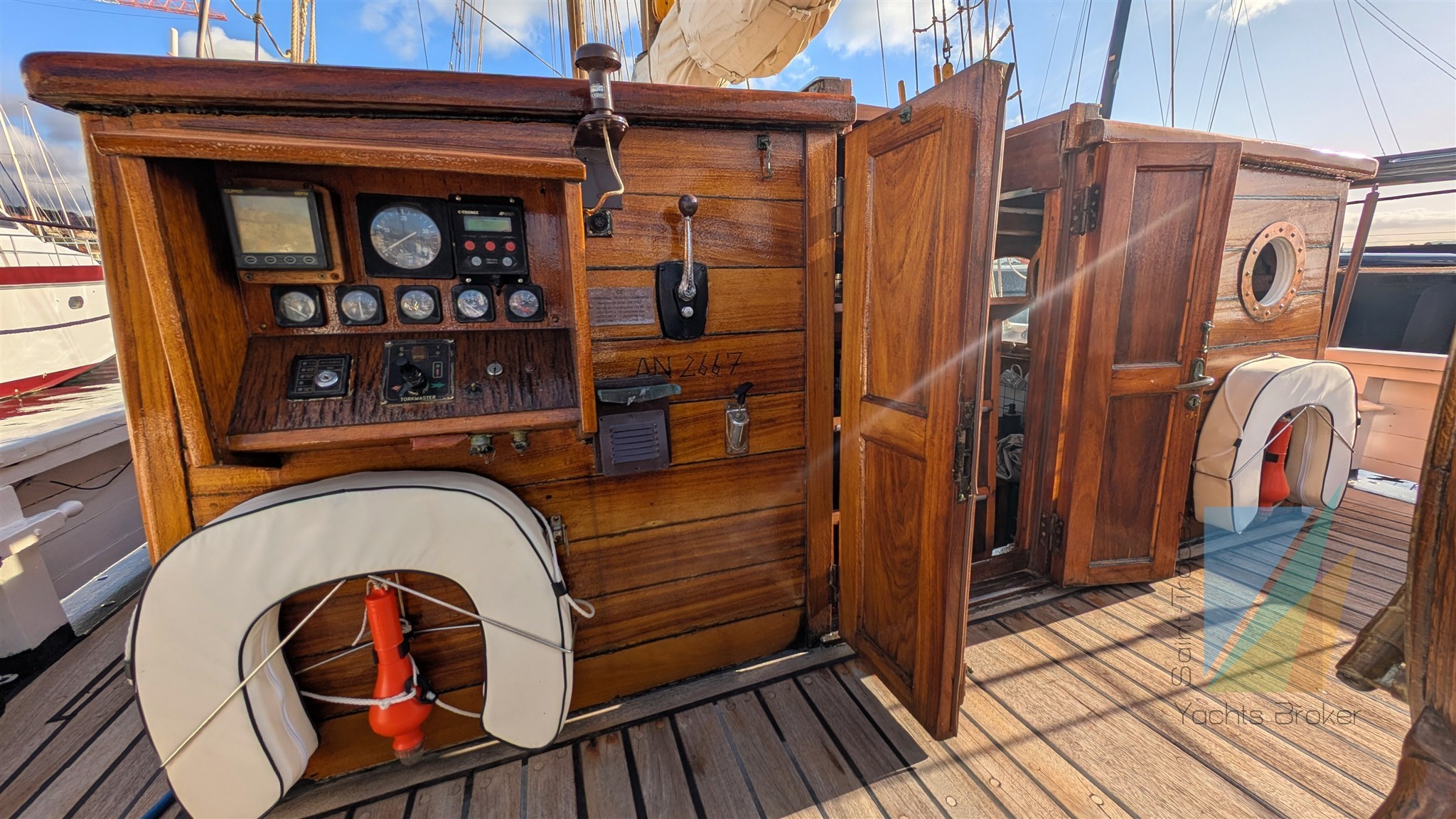
2003: Radar and navigation electronics installation
2004: Installation of a diesel central heating system with a Mikuni boiler + radiators.
2009: New teak deck + restoration of the teak roof
2009: New James Lawrence sails – New mooring line
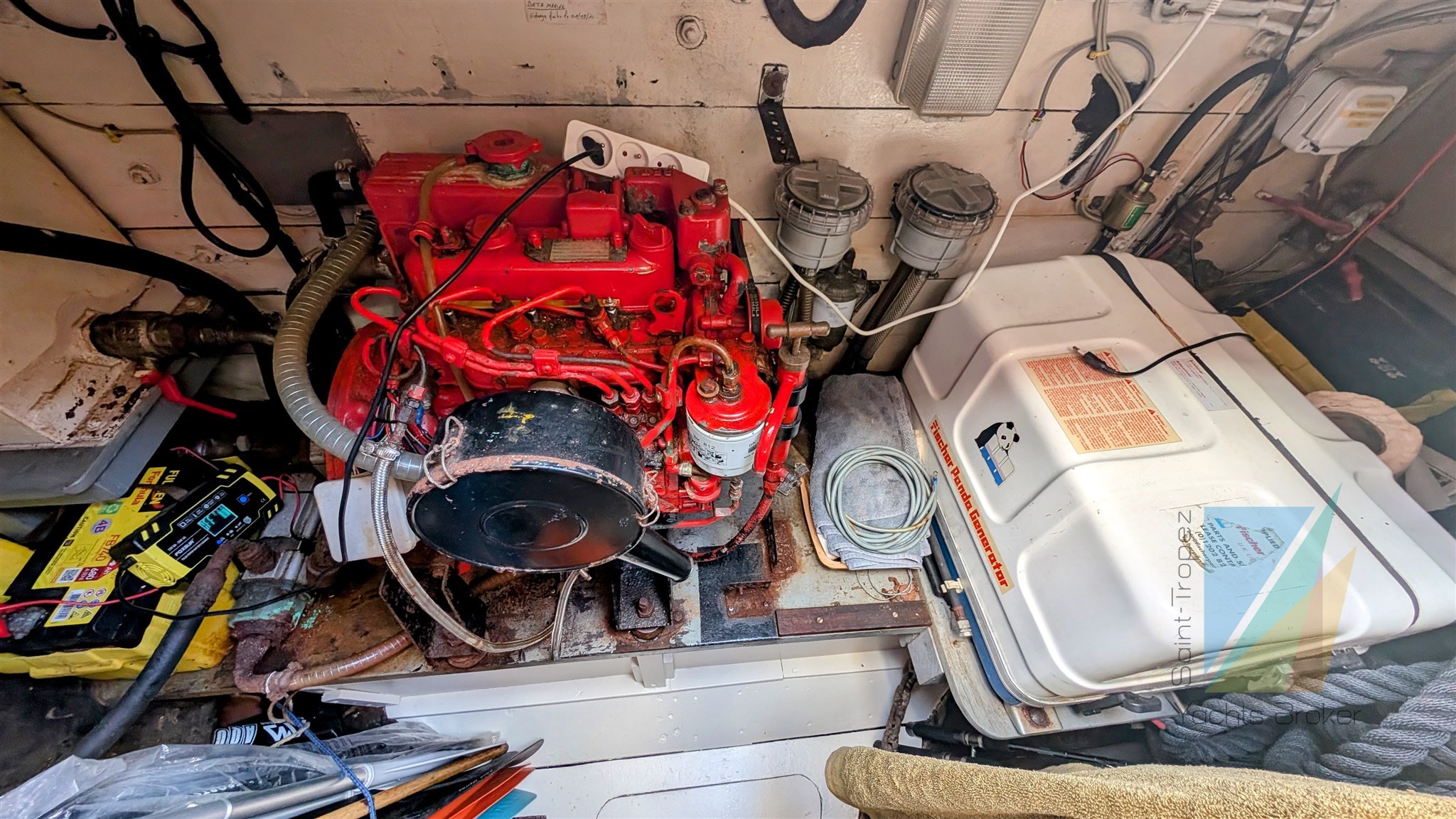
2009: Installation of a Panda 4000 i diesel 4kw generator.
Rigging:
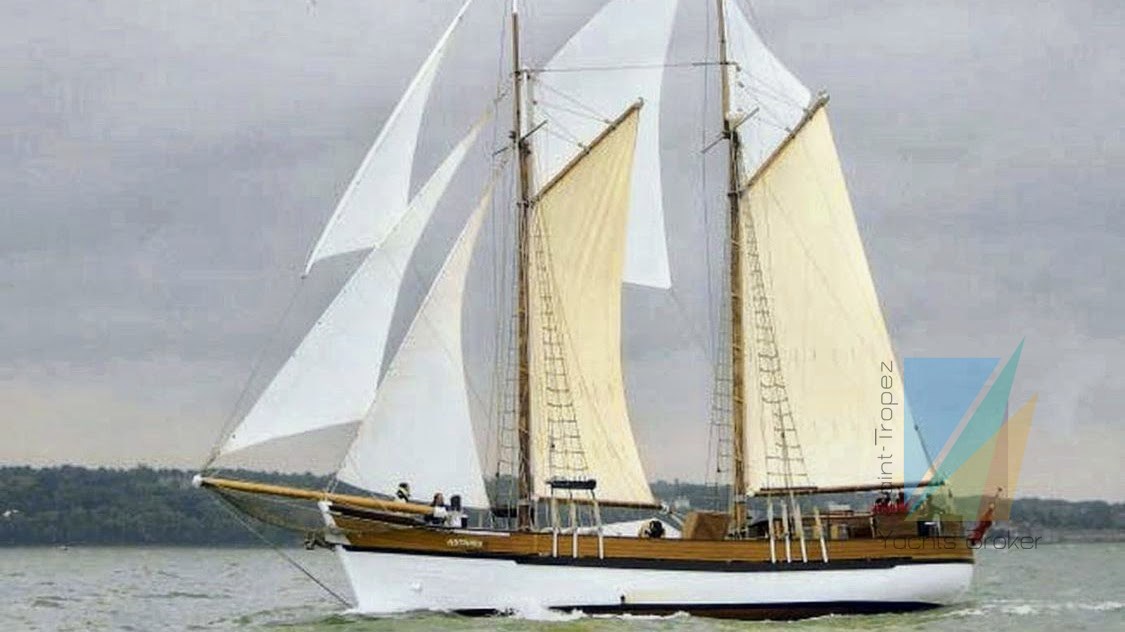
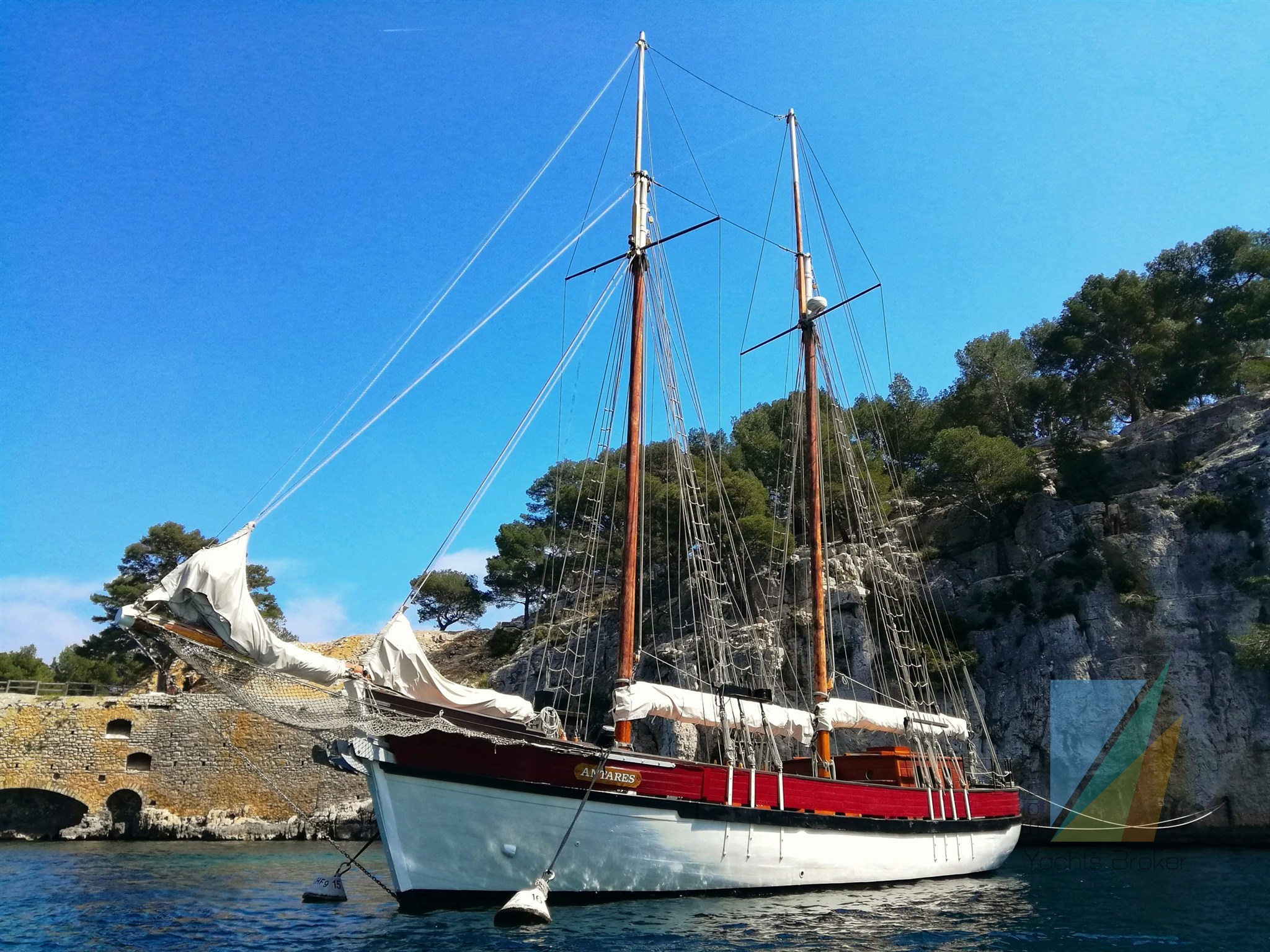
Gaff rig with two masts, booms and horns in Oregon Douglas Fir. Steel guying. Imitation hemp polypropylene ropes (Gautier ropes). Nantes wooden pulleys (restoration 2019).
New swelling on the shrouds (2017). Cabillots for eavesdropping. Sheep caps for rigging.
Brand new bowsprit mast (March 2021 Oregon Douglas fir).
Sails (Very good condition, restoration 2009 by the James Lawrence sailmaker in England):
Mainsail 80m² cotton/polyester – Foresail 50m² cotton/polyester – Staysail 16m² polyester – Jib 18m² polyester – Clin Jib 12m² polyester – Fisherman 28m² polyester – Cargo sail – Polyester jib sail. Mainsail and foresail on Lazy jacks. (Sails overhauled in December 2020 by the Atelier des Voiles)
Awnings: New 2018: Helm cover – Covers for the galley/roof/clerestory/forward engine room – Mainsail – Foresail. Sun awnings on wheelhouse/roof/clerestory. 2021 : Staysail awnings – Jib – Clapboard – solar awning on kitchen 2021.
Engine:
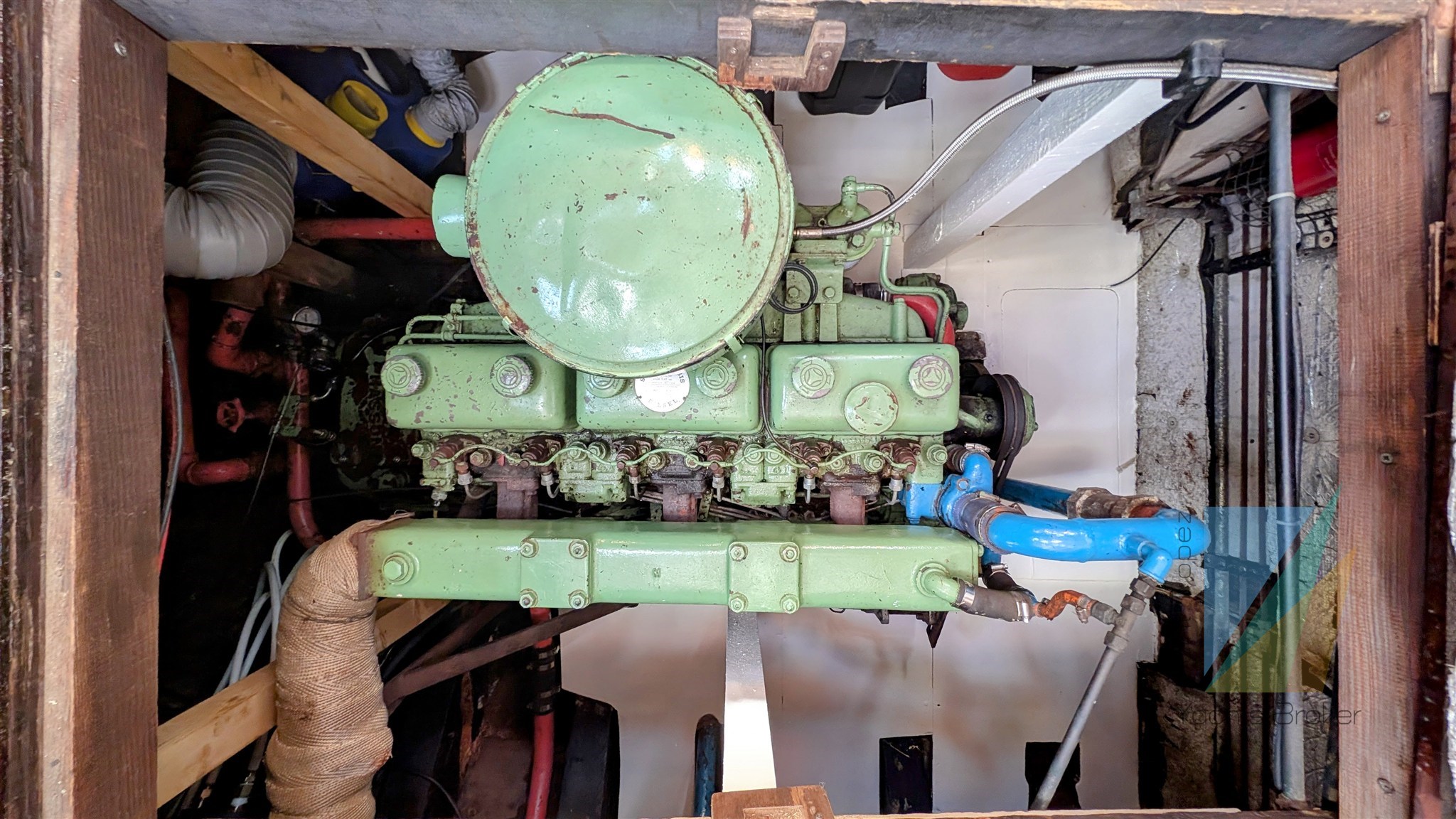
1 x 6-cylinder diesel engine SCANIA VABIS D8 R40 – 125HP/93KW date unknown (Date of premiere
production of these engines by Scania in 1960). Masson inverter/gearbox ratio 3.1. Regular maintenance new hydraulic pump 2023 - 1 BETA MARINE 28HP engine for hydraulic power plant
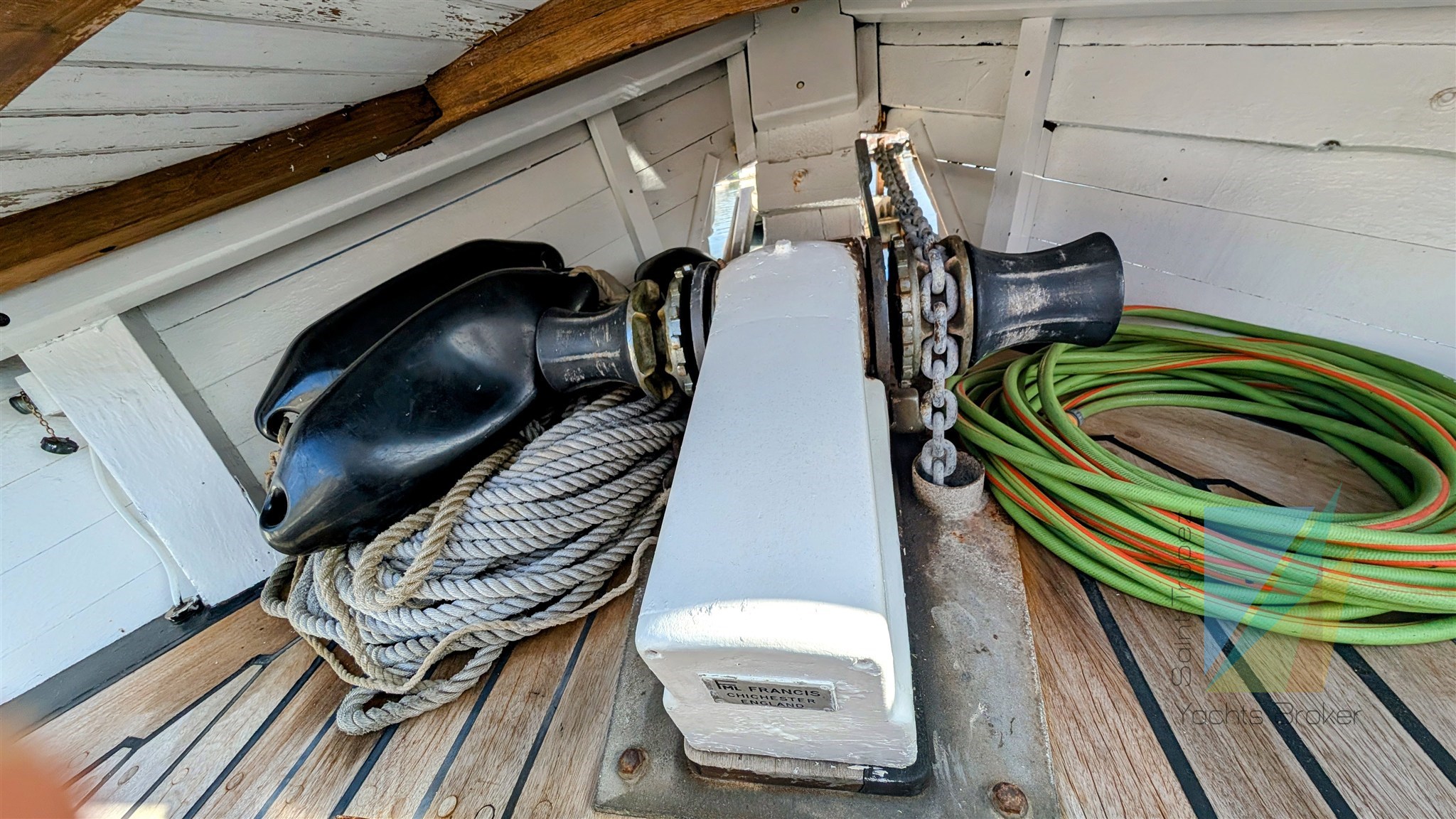
Torkmaster (FMR Francis windlass + bow thruster).
Facilities:
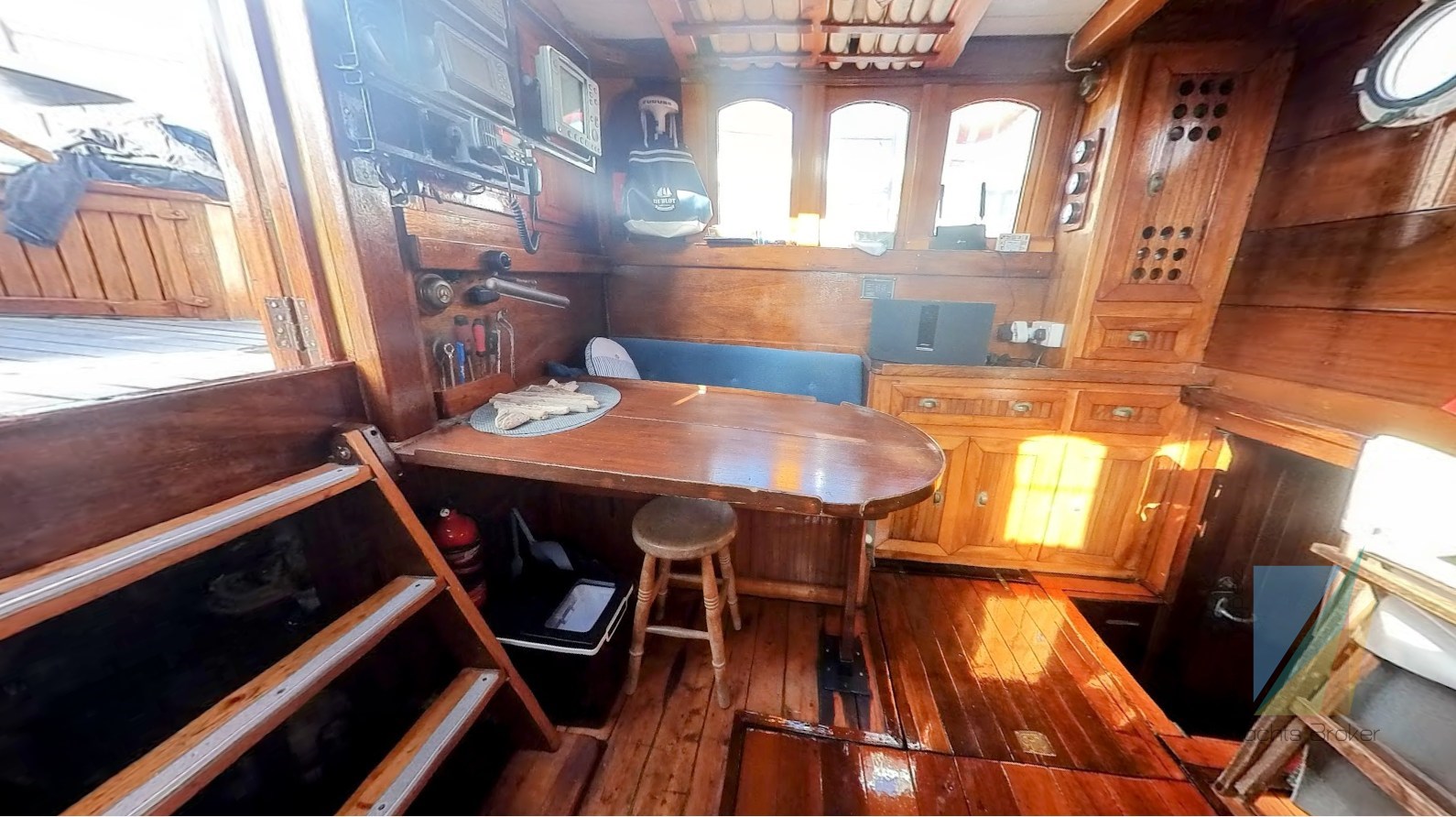
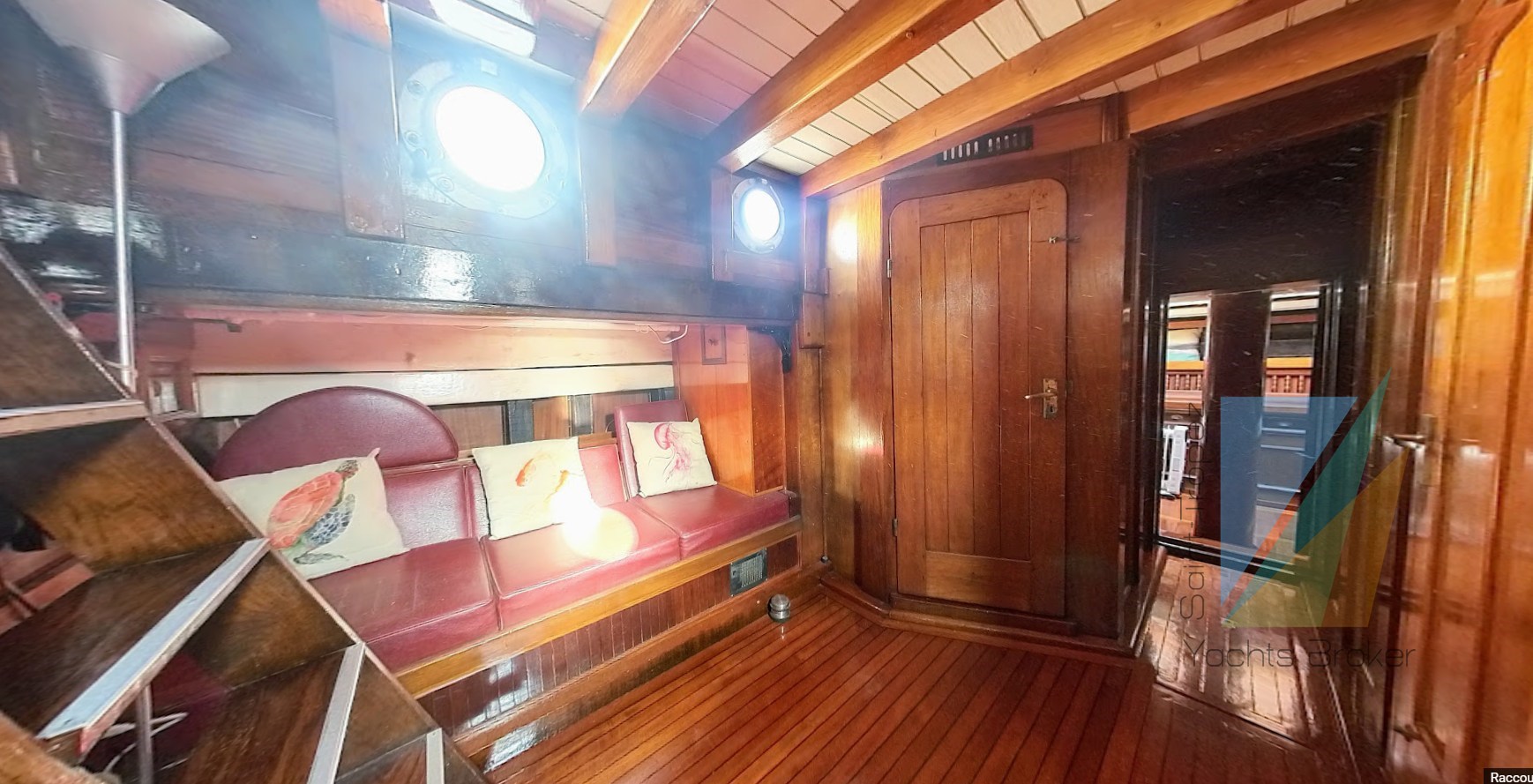
Mahogany and oak interior
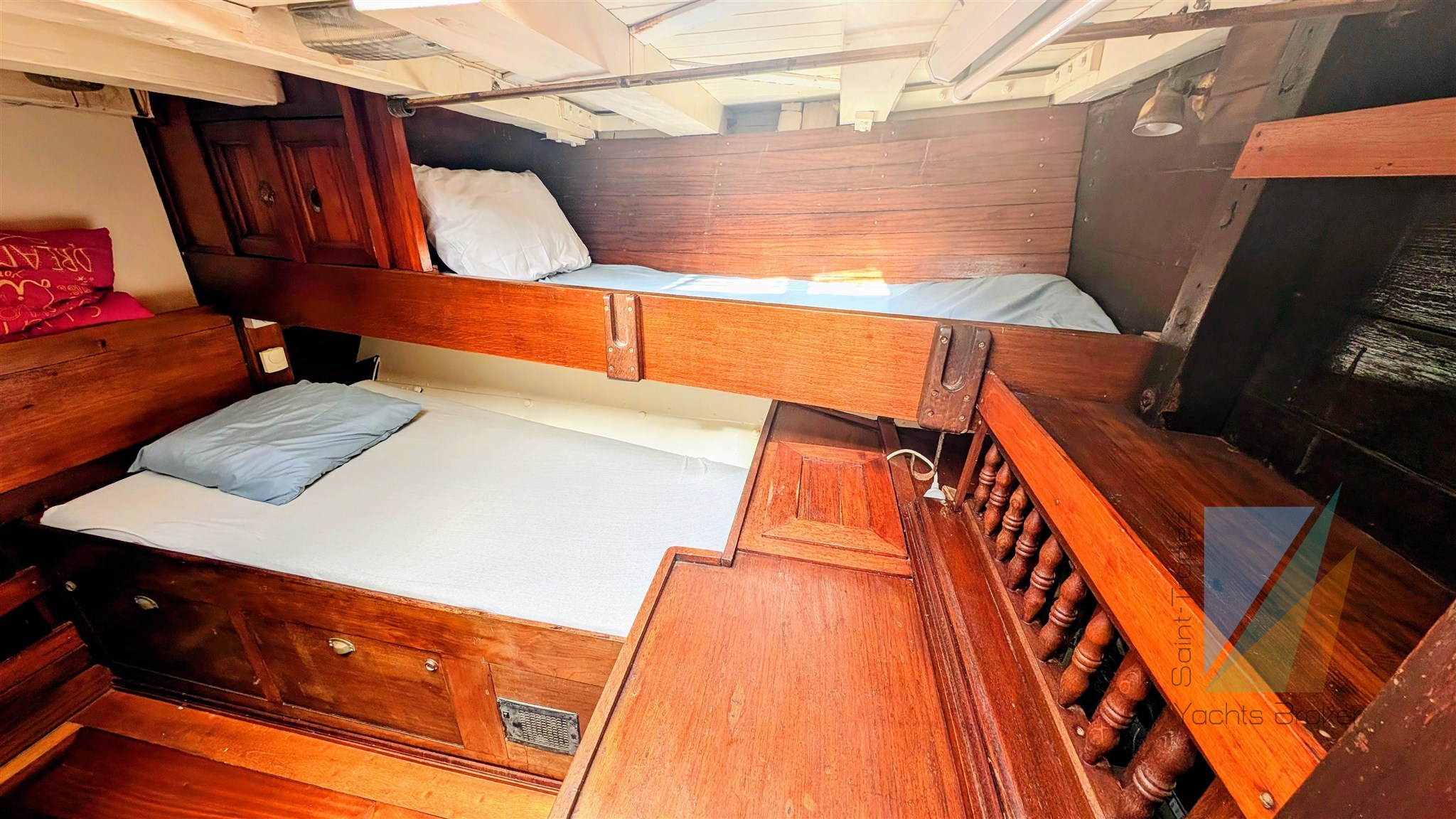
1 large forward cabin with 2 double berths 115cm – 2 upper single berths 80cm – 1 canvas bed
1 owner's cabin with double bed 120cm
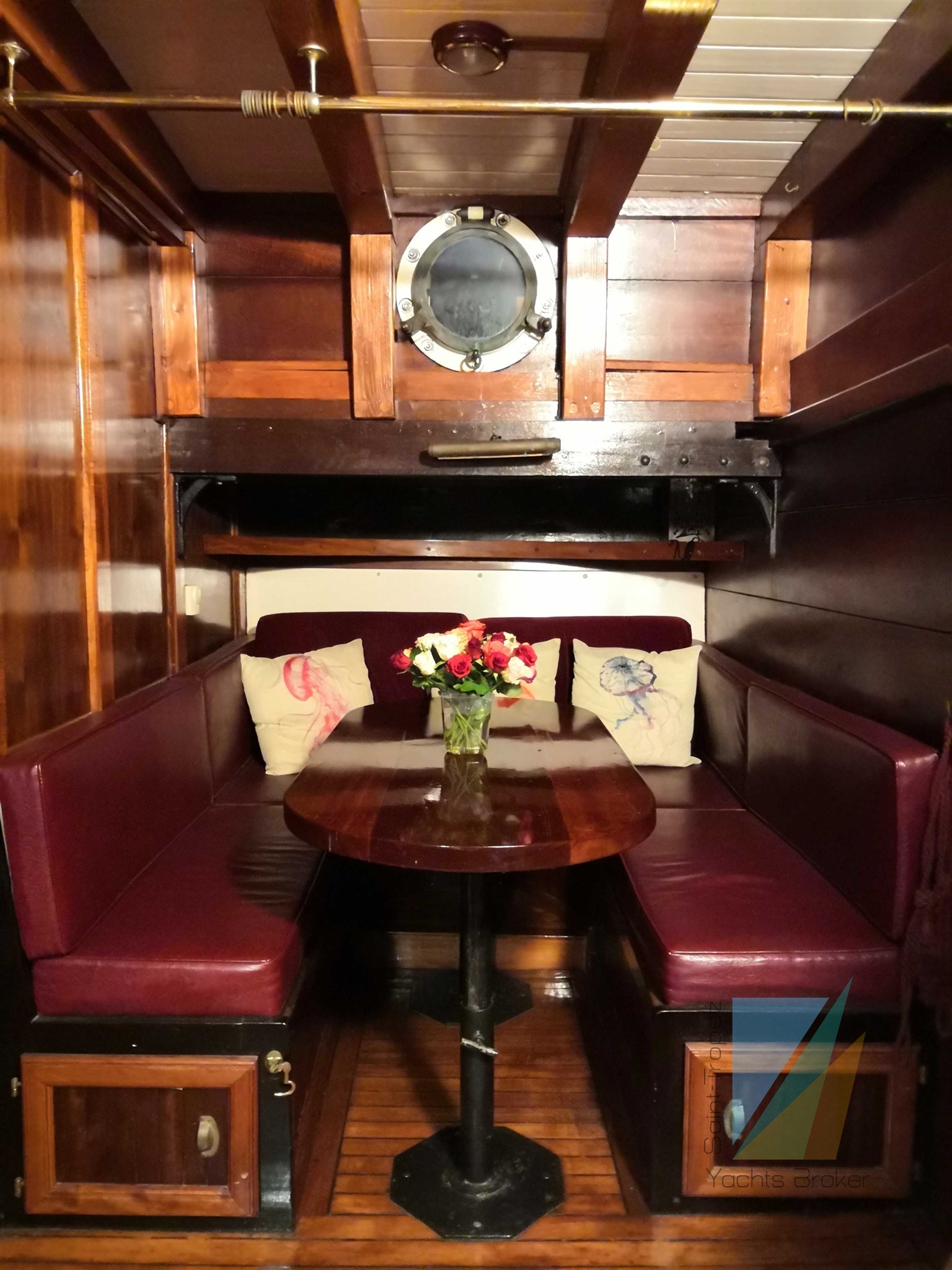
1 low square with table for 10 people that can be converted into a 140cm bed + 1 bench that can be transformed into a single bed
1 bathroom with bath (new taps) hot water – 1 toilet type Sanimarin 31 electronic
(2017) – 1 sink + shelves – black water tank
1 lazarette room with spare/stock store + 1 fridge/freezer + 1 top fridge.
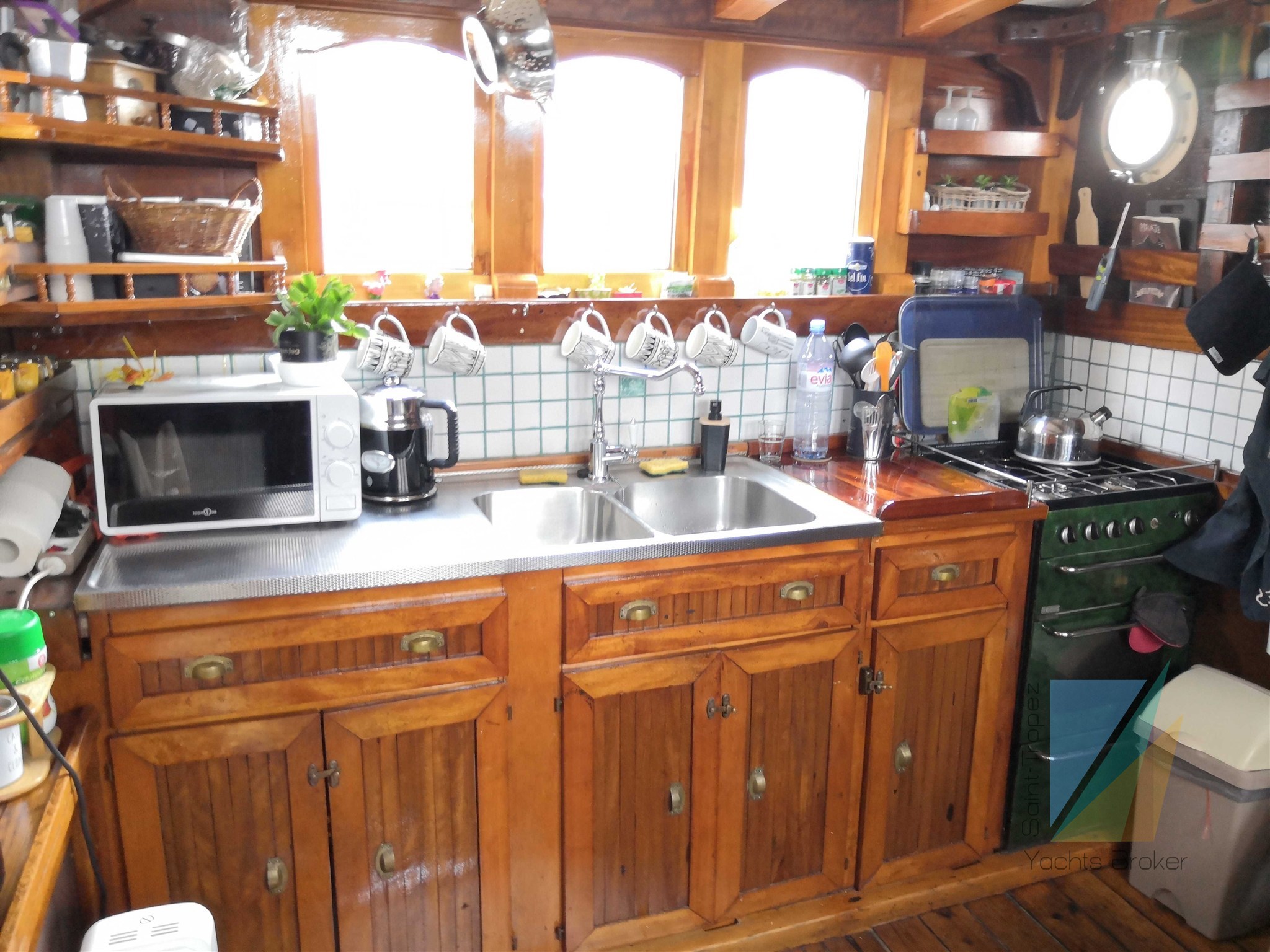
1 High square dog house type with map table and kitchen including gas stove + oven, double sink with hot water – dishwasher – microwave oven – coffee maker + crockery storage.
1 crew bedroom with 1 double bed (135cm) + "workshop" compartment
1 main machine room under the kitchen (main engine/battery park/VMC)
Electricity:
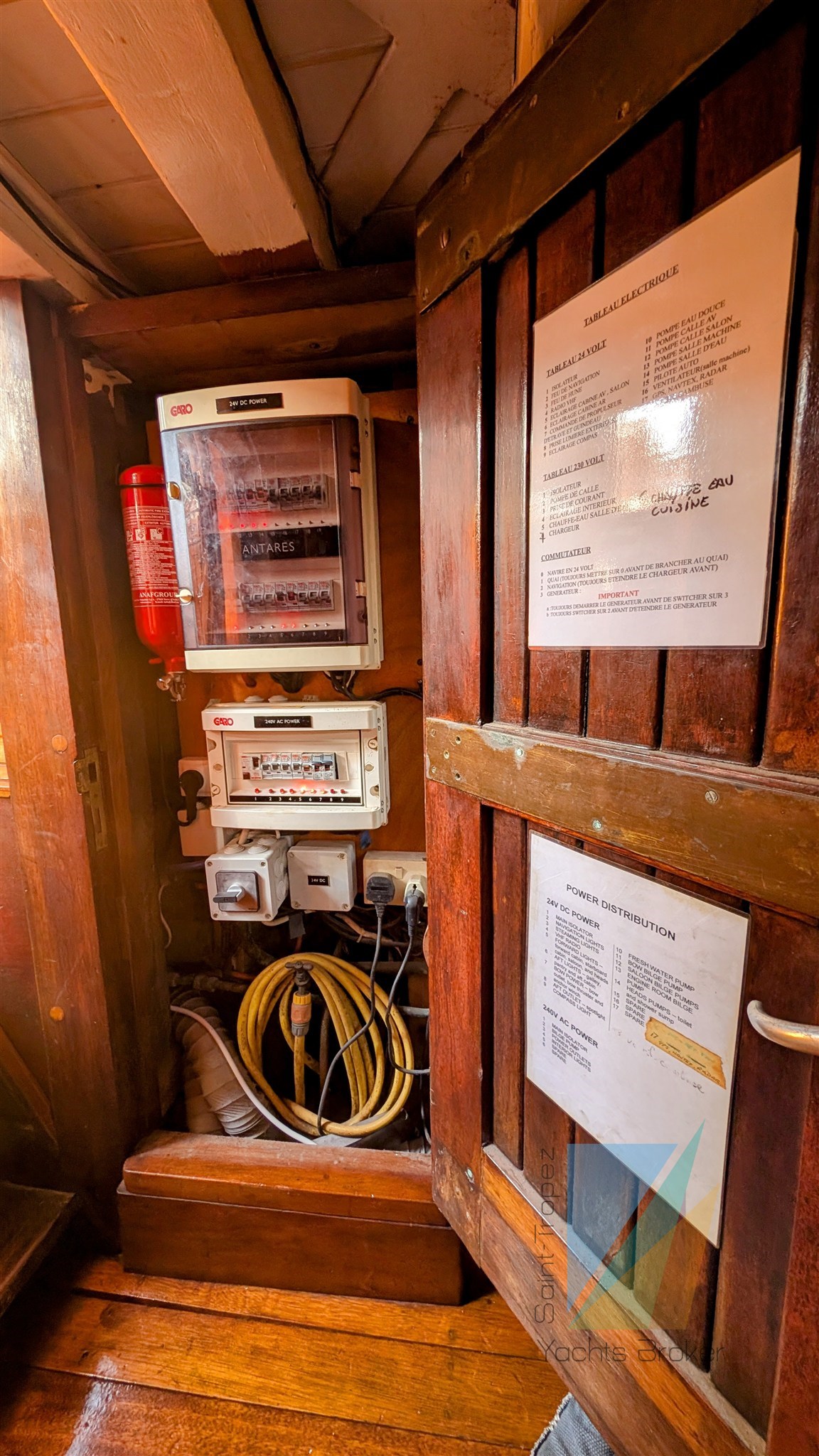
24/220V electrical panel
10 square dock cable + new shore outlet (2019)
24V/220V including navigation
Mastervolt charger (shore power supply or on Panda) + alternator engine charger
1 service park – 1 start-up park – switchable in the event of a problem with one of the two batteries
New - Autonomous 12V hydraulic power plant
Autonomous Panda in 12V
Boat safety:
Fire: Automatic fire extinguishers in engine rooms + 1 fire extinguisher per room. (Changed in July
2019) Revision March 2024 - 1 fire blanket in the kitchen – Double safety on English socket
(cut-off button + fuse on socket) – Differentials on panel. C-curve circuit breakers on board
220V.
Buoyancy:
5 sumps: 1 front engine room – 2 lower saloon – 1 lazarette – 1 main engine room.
Doubled automatic electric pumps + 2 high-flow manual bilge pumps (1 inside lazarette level – 1 outside port linkage level).
Navigation safety:
Offshore equipment
25 life jackets including 8 ocean-going ones.
3 Round Buoys – 2 Horseshoe Buoys + Auto Flip Light (New 2021)
Licensed boat for up to 25 people in coastal navigation / 8 offshore
1 new dinghy 290 + 1 PARSON 5CV outboard (2017). 1 Survival 8 people revised March 2024
Electronics:
GPS Furuno GP32
Navtex Furuno NX 300
Raymarine SL 72 multifunction radar, route plotter, chart, depth sounder and log.
VHF M-TECH 500 with DSC
Autopilot
Fluids:
Water: 1000L food tanks
Diesel: 1000L
Diesel front engine room: 30L
Movement Speed:
Sailing downwind: Mainsail/Foresail/Staysail/Jib/Clin Jib hoisted in 15/18knots of wind =
speed of 6 knots.
Engine: 6 knots at 1200rpm, consumption 10l/hour (maximum speed 1600rpm).
1946: Seizure of war by the Netherlands
1960/1990: Fishing boat under the Dutch flag.
1990/2005: Antarès is bought by a Dutch family who have completely restored it and converted it into a habitable schooner. Sailing in Norway, Sweden and the Baltic.
2005/2010: Passage under the English flag as a training boat and then a ship based on the west coast of Scotland. Antarès has also contributed to the production of the nautical charts of the OPEN CPN software.
(http://www.antarescharts.co.uk/).
2010/2012: Passage under the French flag at its first home port Sanary/Mer. Year of classification as a BIP (Boat of Heritage Interest) in view of its rich history and its ongoing maintenance.
2012/2017: New home port in Marseille and use as a charter boat.
2017 to date: Private pleasure boat.
Antarès is a very comfortable and pleasant habitable schooner to live in on a daily basis. Outside, its wide open deck of about 80m² even allows you to carry a 4-seater jacuzzi on the roof. The bow swells and bow net are an inexhaustible playground and jumps for children (adults too!). Inside, it is a real apartment of about 70m² in which you can live all year round (The Dutch family who converted Antarès into a schooner was a couple and their two children who lived on it for 15 years). When sailing, her main sails are majestic and always an emotion that is renewed each time. In addition, Antarès heels very little under sail and is very comfortable.
Type of construction:
Hull: Oak planks (Iroko/Niangon for the changed planking) of 45mm on oak lined chords every 30cm.
Superstructure: The teak deck (2009) and the interior/exterior of the living areas is made of mahogany.
Current condition: Very good condition as the boat has undergone several major hull restorations in 1990, 1997, 1998, 2006, 2007, 2009, 2011, 2012, 2013, 2016, 2019, 2021, 2024.
1990: Conversion to a pleasure boat
1998: Installation of a 28HP diesel hydraulic power plant - windlass - bow thruster
2002: Restoration of the steering wheel + switch to hydraulics
2003: Radar and navigation electronics installation
2004: Installation of a diesel central heating system with a Mikuni boiler + radiators.
2009: New teak deck + restoration of the teak roof
2009: New James Lawrence sails – New mooring line
2009: Installation of a Panda 4000 i diesel 4kw generator.
Rigging:
Gaff rig with two masts, booms and horns in Oregon Douglas Fir. Steel guying. Imitation hemp polypropylene ropes (Gautier ropes). Nantes wooden pulleys (restoration 2019).
New swelling on the shrouds (2017). Cabillots for eavesdropping. Sheep caps for rigging.
Brand new bowsprit mast (March 2021 Oregon Douglas fir).
Sails (Very good condition, restoration 2009 by the James Lawrence sailmaker in England):
Mainsail 80m² cotton/polyester – Foresail 50m² cotton/polyester – Staysail 16m² polyester – Jib 18m² polyester – Clin Jib 12m² polyester – Fisherman 28m² polyester – Cargo sail – Polyester jib sail. Mainsail and foresail on Lazy jacks. (Sails overhauled in December 2020 by the Atelier des Voiles)
Awnings: New 2018: Helm cover – Covers for the galley/roof/clerestory/forward engine room – Mainsail – Foresail. Sun awnings on wheelhouse/roof/clerestory. 2021 : Staysail awnings – Jib – Clapboard – solar awning on kitchen 2021.
Engine:
1 x 6-cylinder diesel engine SCANIA VABIS D8 R40 – 125HP/93KW date unknown (Date of premiere
production of these engines by Scania in 1960). Masson inverter/gearbox ratio 3.1. Regular maintenance new hydraulic pump 2023 - 1 BETA MARINE 28HP engine for hydraulic power plant
Torkmaster (FMR Francis windlass + bow thruster).
Facilities:
Mahogany and oak interior
1 large forward cabin with 2 double berths 115cm – 2 upper single berths 80cm – 1 canvas bed
1 owner's cabin with double bed 120cm
1 low square with table for 10 people that can be converted into a 140cm bed + 1 bench that can be transformed into a single bed
1 bathroom with bath (new taps) hot water – 1 toilet type Sanimarin 31 electronic
(2017) – 1 sink + shelves – black water tank
1 lazarette room with spare/stock store + 1 fridge/freezer + 1 top fridge.
1 High square dog house type with map table and kitchen including gas stove + oven, double sink with hot water – dishwasher – microwave oven – coffee maker + crockery storage.
1 crew bedroom with 1 double bed (135cm) + "workshop" compartment
1 main machine room under the kitchen (main engine/battery park/VMC)
Electricity:
24/220V electrical panel
10 square dock cable + new shore outlet (2019)
24V/220V including navigation
Mastervolt charger (shore power supply or on Panda) + alternator engine charger
1 service park – 1 start-up park – switchable in the event of a problem with one of the two batteries
New - Autonomous 12V hydraulic power plant
Autonomous Panda in 12V
Boat safety:
Fire: Automatic fire extinguishers in engine rooms + 1 fire extinguisher per room. (Changed in July
2019) Revision March 2024 - 1 fire blanket in the kitchen – Double safety on English socket
(cut-off button + fuse on socket) – Differentials on panel. C-curve circuit breakers on board
220V.
Buoyancy:
5 sumps: 1 front engine room – 2 lower saloon – 1 lazarette – 1 main engine room.
Doubled automatic electric pumps + 2 high-flow manual bilge pumps (1 inside lazarette level – 1 outside port linkage level).
Navigation safety:
Offshore equipment
25 life jackets including 8 ocean-going ones.
3 Round Buoys – 2 Horseshoe Buoys + Auto Flip Light (New 2021)
Licensed boat for up to 25 people in coastal navigation / 8 offshore
1 new dinghy 290 + 1 PARSON 5CV outboard (2017). 1 Survival 8 people revised March 2024
Electronics:
GPS Furuno GP32
Navtex Furuno NX 300
Raymarine SL 72 multifunction radar, route plotter, chart, depth sounder and log.
VHF M-TECH 500 with DSC
Autopilot
Fluids:
Water: 1000L food tanks
Diesel: 1000L
Diesel front engine room: 30L
Movement Speed:
Sailing downwind: Mainsail/Foresail/Staysail/Jib/Clin Jib hoisted in 15/18knots of wind =
speed of 6 knots.
Engine: 6 knots at 1200rpm, consumption 10l/hour (maximum speed 1600rpm).
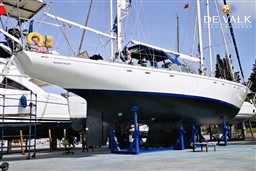
 Brauer-Bützfleth Goélette Aurique is a 19.9 meters Sailboat built in 1945. Moored in Mediterranean Sea (France) is available for sale at 350,000 EUR
on YachtVillage.net. Boat, Boats, Boat For sale, Boats Used, Sailboat For sale, Sailboat Used, Sailboats For sale, Sailboats Used,
Ranking
10 /
10
Brauer-Bützfleth Goélette Aurique is a 19.9 meters Sailboat built in 1945. Moored in Mediterranean Sea (France) is available for sale at 350,000 EUR
on YachtVillage.net. Boat, Boats, Boat For sale, Boats Used, Sailboat For sale, Sailboat Used, Sailboats For sale, Sailboats Used,
Ranking
10 /
10
Brauer-bützfleth Goélette Aurique (1945) - 350,000 EUR
Main data
Shipyard
Brauer-Bützfleth
Model
Goélette Aurique
Year built
1945
Length
19.9
m
Boat Type
Classic/vintage, Cruiser, Cabin Cruiser
Code
876696
Last updated
12/19/2025
Price
Price
350,000 EUR
VAT
VAT Paid
Engines
Power
1 x 125 Hp
Model
Scania VABIS D8 R30
Located
Visible country
France
Visible area
Mediterranean Sea
Located
Marseille
Technical data
Designer
BRAUER
Overall length
19.9
m
Length at waterline
16
m
Width
5.2
m
Height
18.5
m
Draft
2.3
m
Displacement
45,000
kg
Fuel tank
1,000
l
Water tank
1,000
l
Flag
France
Navigation Category
A - Ocean
Hull Shape
Round
Electrical installation
24V, 220V
Accessories
Navigation equipment
Autopilot
Chartplotter (RAYMARINE SL 72)
Compass
DSC vhf
GPS (FURUNO GP 32)
Maps and guides
Navigation lights
Odometer
Radar
Reversing Clutch
Sonar
VHF Radio (M-TECH 500)
Wind Station
Staging and technical
Alternator
Anchor
5 x Automatic Bilge Pump
Batteries (NEUVES)
Battery charger
Bilge Alarm
Bow Thruster
cockpit table
Engine Alarm
Fenders
Gangway
Hydraulic Windlass (FMR FRANCIS)
Life Raft
2 x Manual Bilge Pump
Outboard engine for tender (PARCSON 5CV (2017))
Shore power cable
Shorepower connector
Strand rigging
swimming ladder
Teak Deckhouse
Teak Cockpit
Teak Side Decks
Tender
Water pressure pump
Domestic Facilities onboard
220V Outlets
Black Water Tank
Electric Toilet
Engine oil pressure gauge
Engine temperature gauge
Fuel Tank Indicator
Heater
Interior wooden floor
Inverter
Warm Water
Warm Water System
Water System
Water Tank Meter
Security equipment
Barometer
Binoculars
4 x Emergency Handheld Fires
5 x Fire extinguisher
First aid kit
Life buoy
Lifebuoy With Safety Rope and Light Buoy
Liferaft (8 pax (Révisée 2024))
MOB
Nautical charts
3 x Parachute flares with red light
25 x PFDs
Radar reflector
Safety equipment beyond 50 miles
Self-draining cockpit
2 x Smoke buoy
Entertainment
Radio AM/FM
Sails accessories
Bowsprit
Sail Bag
Staysail forestay
Kitchen and appliances
Burner
Coffee Machine
Dishwasher
Freezer
Galley
Microwave Oven
Oven
Refrigerator
Upholstery
Bimini
Cockpit Cover
Mattresses
Sprayhood
Sunshade
Do you want to know more about this boat?
Habitability
Number of cabins
8
Number of bathrooms
1
Cabins berths
12
Total berths
12
Composition

4 x Double Queen Size
1° Double Queen Size
135 CMS
2° Double Queen Size
115 CMS
3° Double Queen Size
115 CMS
4° Double Queen Size
120 CMS

4 x Single
1° Single
115 cms
2° Single
115 cms
3° Single
80 CMS
4° Single
80 CMS

Dinette

Living
transformable en lit 140 cms

Kitchen

Toilet with shower no bidet
Materials
No data available
Sails

Mast
2 mâts

2 x Mainsail
1° Mainsail
GV 80 m2
2° Mainsail
Misaine 50 m2

Genoa

2 x Jib
1° Jib
Clin Foc 12 m2
2° Jib
18 m2

Spinnaker
Polyester x 2

Staysail
16 m2

Fisherman
28 m2
Do you want to know more about this boat?
 360° panoramas

SAINT TROPEZ YACHTS BROKER
+33 609 569 595
+33 644 074 033
route de la plage MAJOR BOATS - 83310 - COGOLIN
Other boats that may interest you...
-
![Image]() Custom Built/eigenbau Custom Built Trandil (2008)329,000 EUR
Custom Built/eigenbau Custom Built Trandil (2008)329,000 EUR -
![Image]() Picchiotti Laurent Giles 65 (1984)350,000 EUR
Picchiotti Laurent Giles 65 (1984)350,000 EUR

In YachtVillage
© 2025 YachtVillage - Design by Digibusiness Srl - P.IVA IT02184210348 - Powered by Navis.net